
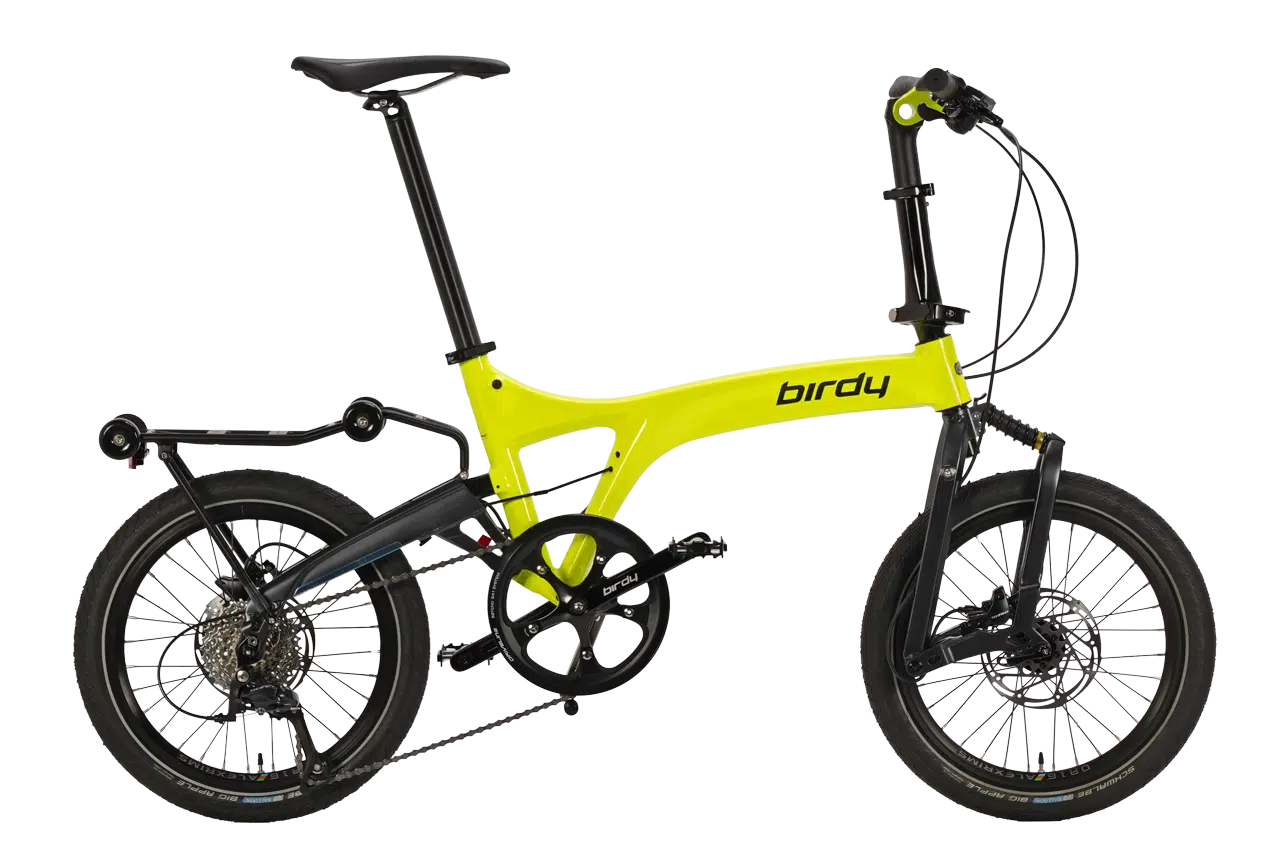
Welcome to our Birdy vs Brompton comparison. If you’re shopping for a premium folding bike, these two names come up again and again. Both are hand-built with decades of engineering heritage — one in London, one in Taiwan via German design. But they take fundamentally different approaches to the folding bike formula. This guide compares the current models: Birdy EVO / URB / GV Plus vs Brompton C Line.
At a Glance: Birdy vs Brompton
| Dimension | Birdy (EVO / URB) | Brompton C Line |
|---|---|---|
| Price Range | $1,700 – $1,900 | $1,550 – $1,750 |
| Weight | 11.0 – 11.5 kg | 11.3 – 12.0 kg |
| Wheel Size | 18-inch | 16-inch |
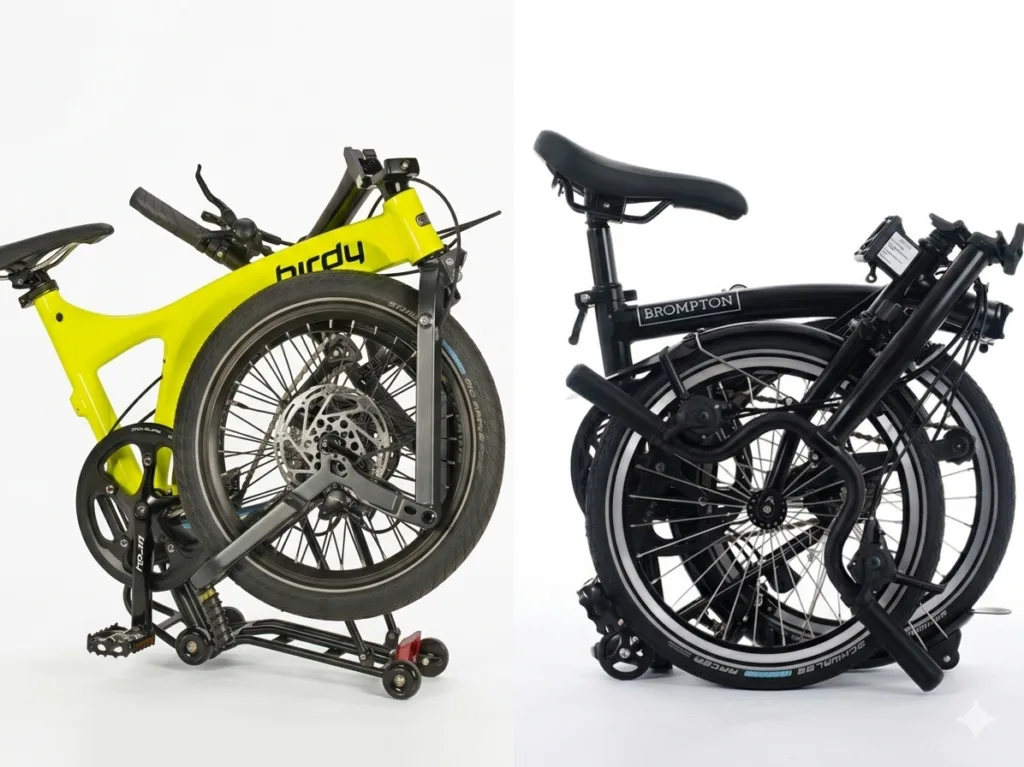
| Folded Size | 75 × 32 × 65 cm | 58.5 × 56.5 × 27 cm |
| Suspension | Front fork + rear PU (full) | Rear block only |
| Gears | 9-speed (URB) / 10-speed (EVO) | 4-speed / 12-speed |
| Brakes | Tektro hydraulic (URB) / TRP Spyre (EVO) | Caliper rim brakes |
| Frame Material | Aluminum (6061/7005) | Hand-brazed steel |
| Country of Origin | Taiwan (Pacific Cycles) | London, UK |
Ride Quality
This is the biggest difference between the two bikes.
Birdy: Full front suspension fork plus a rear PU elastomer make the Birdy the clear winner for ride comfort. As Cycling UK noted in their comparison test: “Suspension is the biggest differentiator between the two. The Birdy has it; the Brompton doesn’t. On rough urban roads, the Birdy feels assured and planted. On the same surface, the Brompton feels harsh.” The 18-inch wheels also roll over cracks and cobblestone more smoothly than the Brompton’s 16-inch wheels.
Brompton: The steel frame absorbs some road vibration, and the rear suspension block helps, but there is no front suspension. On smooth pavement, the ride is fine — even pleasant. On rough city streets, the 16-inch wheels transmit every crack and bump to your hands. Wirecutter said it “comes close to a full-size bike experience on the road” — but that’s compared to other folders, not to a Birdy.
Winner: Birdy — the suspension makes a significantly more composed ride quality on anything but perfect pavement.
Portability & Fold
Brompton: This is where the Brompton is industry benchmark for compactness. Its 3-part fold produces the smallest folding package of any full-size folding bike. Cycling UK called it: “10-15 seconds to fold, second nature with practice.” It fits in overhead luggage racks, under restaurant tables, and in standard office lockers. The optional rolling rack lets you push it like a shopping cart through stations — a killer feature for multi-modal commuters.
Birdy: The Birdy folds larger (75×32×65 cm vs 58.5×56.5×27 cm). The fold takes about 25-30 seconds — functional but not as elegant. The URB model has a built-in rolling rack (pull-handle style) which is excellent on tile and concrete, but the folded package is noticeably larger. The 18-inch wheels make the folded bundle bulkier.
Winner: Brompton — smaller, faster fold, easier to carry and store.
Brakes
Birdy: The URB has Tektro hydraulic disc brakes — genuine hydraulic stopping power with excellent modulation and wet-weather performance. The EVO and GV Plus use TRP Spyre mechanical discs (cable-actuated). Even the mechanical discs are a significant step up from rim brakes.
Brompton: All C Line models use dual-pivot caliper rim brakes. They stop adequately in dry conditions, but stopping power drops noticeably in the rain, and the rims wear over time. This is one of the most common upgrades Brompton owners make (swapping to aftermarket disc fork solutions).
Winner: Birdy — disc brakes, especially hydraulic, are objectively superior in all conditions.
Durability & Resale
Brompton: Hand-brazed steel frame built in London. 7-year warranty. Unmatched resale value — a 5-year-old Brompton sells for 60-70% of its original price. Parts are easy to source globally. This is a buy-it-for-life bike.
Birdy: Pacific Cycles’ aluminum frames are well-built, and the Gen 3 monocoque design is proven over a decade. Resale value is good but not Brompton-level. Parts availability varies by region — easier in Asia and Europe, harder in North America.
Winner: Brompton — better resale, global parts availability, 7-year warranty.
Which Model Should You Buy?
Choose Birdy if:
- Ride comfort is your top priority — the suspension makes a real difference
- You want disc brakes (especially the URB’s hydraulics)
- You ride on rough pavement, cobblestone, or gravel
- You prefer a more traditional bike geometry and feel
- 18-inch wheels suit your terrain
Choose Brompton if:
- Folded size is your top priority — nothing folds smaller
- You commute by train daily and need a bike that disappears
- You value resale value and global parts availability
- You want a British-made product with decades of refinement
- Your riding is mostly on smooth pavement
Quick Model Matchup
| Your Use Case | Birdy Pick | Brompton Pick |
|---|---|---|
| Best all-round city commuter | Birdy EVO ($1,700) | C Line 12-speed ($1,750) |
| Best for train commuters | Birdy URB (rolling rack) | C Line 4-speed ($1,550) |
| Best for rough roads / gravel | Birdy GV Plus ($1,900) | — (G Line, $2,500+) |
| Budget entry | Birdy STD (~$1,400) | A Line (~$1,200) |
Note: Prices shown are US MSRP reference ranges. Actual prices vary by region, configuration, and promotions.
Final Verdict
Buy the Birdy if you prioritize ride quality, comfort, and braking performance. The full suspension transforms the riding experience — especially if your roads aren’t glass-smooth. Cycling UK summed it up: the Birdy “edges ahead in stability thanks to its longer wheelbase and suspension.” It’s the better bike to ride, day in and day out.
Buy the Brompton if you prioritize folded size, portability, and resale value. No folding bike folds smaller, and the build quality is legendary. Wirecutter called it “the gold standard” for a reason. If your commute involves trains, tight storage, or carrying the bike folded through stations, the Brompton’s smaller package is a genuine advantage.
Bottom line: The Birdy is a better bike. The Brompton is a better folder. Choose based on which trade-off matters more to you.
Sources: Wirecutter (The New York Times), Cycling UK bike test review. All trademarks belong to their respective owners.